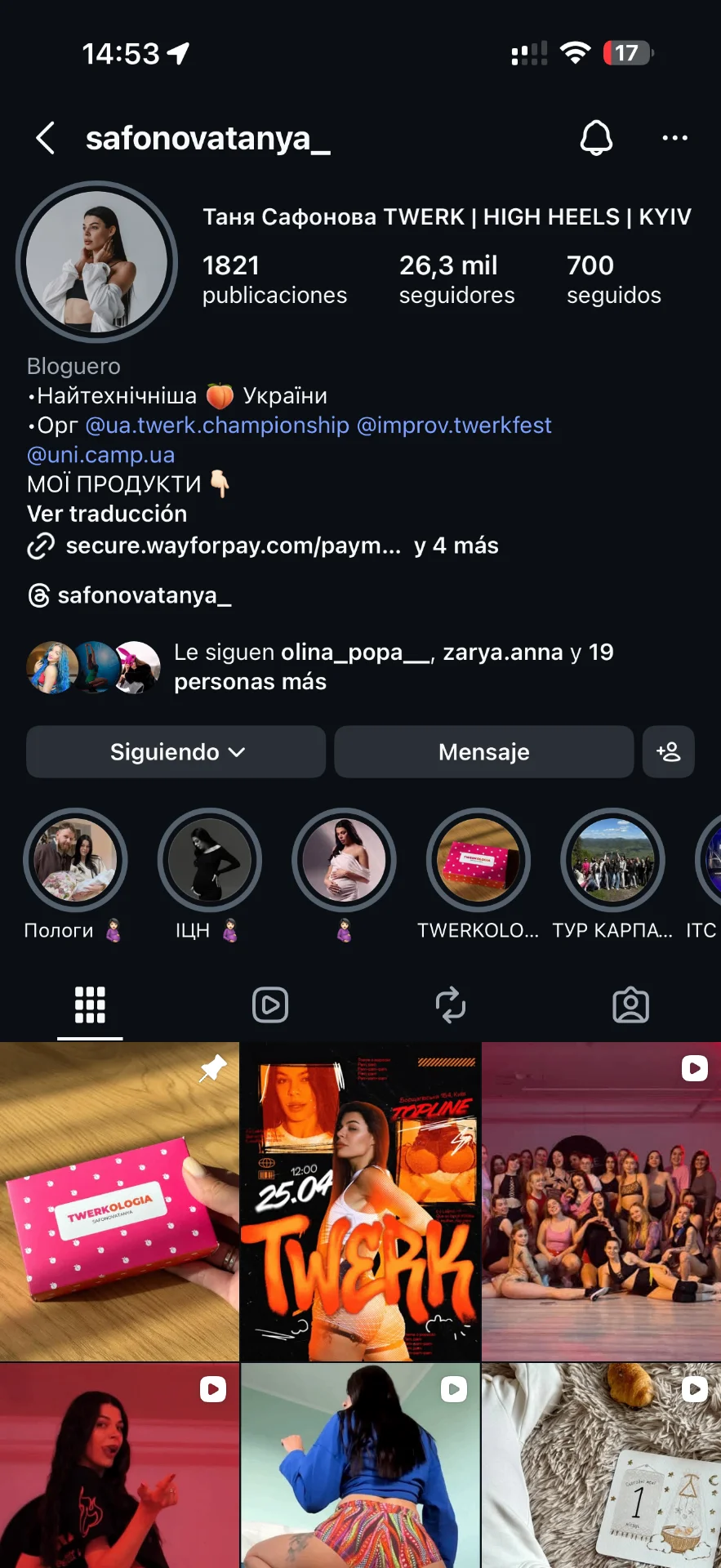
Basic twerk moves for beginners (with video)
There are four foundational moves every twerk dancer should learn before anything else. Master these in order and you’ll have everything you need to start improvising to music.
Move #1 — The Jiggle (Basic Bounce)
The Jiggle is the foundation of twerk. It’s a small, fast vertical bounce powered entirely by your knees. The setup:
- Feet shoulder-width apart, toes turned out roughly 30°.
- Soft bend in the knees — never locked. Weight in the balls of your feet.
- Hands on your thighs just above the knees for support and feedback.
- Tilt your pelvis slightly forward (anterior tilt). Your lower back should feel released, not arched hard.
- Bounce by quickly bending and straightening your knees in a small range. Your butt will jiggle on its own.
Below is the full free lesson where Tanya breaks down the Jiggle from zero — same lesson that opens the paid course.
No email required · Full 11-minute lesson · Watch as many times as you need
Move #2 — The Up/Down
Once the Jiggle is automatic, the Up/Down adds vertical dimension. Instead of staying in one level, you bounce while traveling slowly up to standing and back down to a deep plié. The feet stay planted; only the knees and pelvis move. Done well, this is what creates the dramatic "wave" through the glutes that defines polished twerk.
The Up/Down is also where most beginners realise their plié isn’t deep enough. Lesson 2 of the course breaks down the three variations: standard Up/Down, Up/Down in Plié, and Up/Down on Straight Legs.
UP/DOWN
23 min · 3 videos · Locked lesson
UP/DOWN
What’s inside
- Up/Down — basic mechanic (9:05)
- Up/Down in Plié (7:23)
- Up/Down on Straight Legs (7:19)
$9.75 per lesson · sold as part of the full 4-lesson course ($39 total)
Move #3 — Bubble & Bounce
The Bubble is a sharper, more percussive cousin of the Jiggle — it’s what gives twerk its signature "shake" look on stage. You maintain the bounce mechanic but add a quick contraction in the glutes on each beat. Combined with bouncing into a wall (yes, real technique called "bouncing into the fence") and trampoline variations, this is where twerk starts to look explosive.
BUBBLE & BOUNCE
18 min · 3 videos · Locked lesson
BUBBLE & BOUNCE
What’s inside
- Bubble / Bouncing into the Fence (6:34)
- Trampolines (7:06)
- Shake in Plié (4:08)
$9.75 per lesson · sold as part of the full 4-lesson course ($39 total)
Move #4 — Circles
Circles introduce horizontal motion to the bounce — your hips draw smooth circles in the air while the bounce continues underneath. Mastering circles in the standing, middle, and triangle positions gives you the full vocabulary needed to freestyle to almost any song. This is the move that makes people stop scrolling.
CIRCLES
22 min · 3 videos · Locked lesson
CIRCLES
What’s inside
- Circles & "Horses" (8:06)
- Circles in the Middle Position (4:48)
- Circles in the Triangle Position (9:12)
$9.75 per lesson · sold as part of the full 4-lesson course ($39 total)
Common twerk mistakes & how to fix them
Nine out of ten beginners make the same five mistakes. Fix these and your twerk will jump levels in a single practice session.
- 01Locked knees. Straight legs kill the bounce instantly. Fix: keep a constant soft bend, never fully extend.
- 02Gripping the lower back. An over-arched, tense lower back blocks the pelvis. Fix: release your spine, breathe out, think "soft" not "stuck out."
- 03Pushing the butt instead of bouncing the knees. This is the #1 mistake. Fix: forget about the butt entirely. Focus only on the knee bounce — the butt follows automatically.
- 04Weight on the heels. Heel-loaded weight makes the bounce slow and heavy. Fix: shift weight forward to the balls of your feet.
- 05Practising without music. Twerk without rhythm is just squats. Fix: always practise to music in the right BPM range (see below).
Twerk safety: protecting your knees & lower back
Done correctly, twerk is one of the safest dance styles — low-impact, joint-friendly, and great for hip mobility. Done incorrectly, the two areas at risk are the knees and the lower back. Three rules keep you safe:
- Track your knees over your toes. Never let your knees collapse inward. If your toes point slightly out, your knees should follow that same line.
- Warm up the hips and lower back for 5 minutes. Hip circles, cat-cow, and a few deep pliés are enough.
- Stop if you feel sharp pain — soreness is fine, pain is not. Glute and quad soreness after a session is normal. Sharp knee or lumbar pain means your form is off; review the mechanics.
Pregnant dancers, anyone with existing knee or back injuries, and people with severe joint conditions should consult a doctor or physiotherapist before starting.
The best music BPM for twerking
Music does half the work. The right BPM (beats per minute) range makes the bounce land naturally; the wrong range makes everything feel forced.
- 90–100 BPM — ideal for absolute beginners. Slow enough to think between beats.
- 100–115 BPM — the sweet spot for most modern twerk choreography. Classic New Orleans bounce lives here.
- 115–130 BPM — advanced. Demands clean fundamentals; great for combos and explosive drops.
Reliable starting genres: New Orleans bounce, Atlanta trap, Miami bass, dancehall, Afrobeats, and most mainstream hip-hop singles. Spotify and Apple Music both let you sort playlists by BPM if you want to be precise.
From beginner to advanced: the progression roadmap
Here’s the exact path to follow if you want to go from "I’ve never danced" to "I can freestyle confidently to any song."
Phase 1 — Foundations (Week 1)
Daily 15-min sessions. Goal: clean Jiggle on autopilot. Practice in front of a mirror. Stay slow.
Phase 2 — Core moves (Weeks 2–4)
Add Up/Down, Bubble, and Circles one at a time. Don’t move to the next until the previous feels easy.
Phase 3 — Combinations (Month 2)
Start linking moves to the beat. Practice transitioning between standing, plié, and triangle positions.
Phase 4 — Freestyle (Month 3+)
Pick a song you’ve never practised to and improvise for the full length. This is the moment most students realise: they can twerk.
Frequently asked questions
How do you twerk for beginners?+
Stand with feet shoulder-width apart, toes turned out about 30°, and softly bend your knees — never lock them. Place your hands on your thighs above the knees and tilt your pelvis slightly forward. Bounce by quickly bending and straightening your knees in a small range. Your glutes will jiggle on their own — that’s the basic twerk.
Can anyone learn to twerk?+
Yes. Twerking scales to any body type, age, and fitness level — students range from 18 to 60+ with zero dance background. You don’t need natural rhythm, flexibility, or a specific body shape. The only requirement is following a structured progression: master the knee-driven bounce first, then layer variations on top.
What muscles do you use to twerk?+
Twerking primarily works the quadriceps and calves (driving the knee bounce), the glutes and hip flexors (controlling pelvic tilt), the hamstrings (stabilizing the squat position), and the core and lower back (maintaining posture). It’s a full lower-body workout that also builds coordination and body awareness.
Is twerking good exercise?+
Yes. A 20-minute twerk session burns 150–250 calories and works glutes, quads, hamstrings, calves, core, and lower back. It’s low-impact and joint-friendly — easier on knees than running. Most students report visible glute tone, better posture, and improved hip mobility within 4–6 weeks of consistent practice.
What is twerking?+
Twerking is a rhythmic dance movement where you bounce and shake your hips and glutes by quickly flexing and extending your knees. Despite the name, it’s not a 'butt move' — the entire motion is generated by the knees and pelvis; the glutes simply respond. The word entered mainstream English around 1993 in the New Orleans bounce music scene (DJ Jubilee, later Big Freedia), but the movement itself is far older, with roots in West African traditions like the Ivorian Mapouka and across the African diaspora. Oxford Dictionary officially added 'twerk' as a verb in 2013.
Is twerking hard to learn?+
Short answer: no. Twerking is significantly easier than most dance styles because it’s built around one repeating mechanic — a controlled knee bounce — that, once learned, unlocks dozens of variations. The reason it feels hard to most beginners is that they start by copying a finished move from TikTok: they lock their knees, push the butt out, grip the lower back, and nothing moves. That’s not a talent problem, it’s a sequencing problem — they skipped the mechanics. Learn the bounce first as a stand-alone skill and every other move becomes a small variation on something your body already knows.
How long does it take to learn to twerk?+
With 15 minutes of structured daily practice: a clean basic bounce in 5–7 days, Up/Down + Shake + position changes by weeks 2–3, smoothly combining 3–4 moves to a beat by week 4, and confident freestyle to any song in 2–3 months. Without structure, most people plateau on a shaky basic bounce for months because they keep trying to skip ahead — structured practice is roughly 4x faster.
Can a complete beginner learn how to twerk at home?+
Yes. You don’t need a studio, partner, or natural rhythm — just 1.5 m² of floor space and a mirror or phone camera. Beginners actually progress faster at home because they’re not self-conscious. The only requirement is following a structured progression instead of jumping between random tutorials.
Why do my hips feel stiff when I try to twerk?+
Stiff hips are almost never about flexibility — they’re about tension in the lower back and locked knees. If your knees are straight, your pelvis can’t move freely. Soften your knees into a small bend, tilt your pelvis slightly forward, and let your lower back relax. The bounce will start happening on its own.
What’s the best music BPM for learning to twerk?+
For beginners, 90–100 BPM is ideal — slow enough to control each bounce, fast enough to feel the groove. Once you have the basics, 100–115 BPM is the sweet spot for most twerk choreography. Classic New Orleans bounce sits around 95–105 BPM, which is why it’s the natural home of twerk.
Do I need to be in shape or have dance experience?+
No. Twerk scales to your body, age, and fitness level. The course has students from 18 to 60+, every body type, with zero dance background. The only thing that matters is willingness to practice the fundamentals before chasing advanced moves.
READY TO LEARN PROPERLY?
The full course covers all 14 techniques in this guide with video for every move — taught by Tanya Safonova, an international twerk champion with 9+ years of teaching experience.
One-time payment · Lifetime access · 14 lessons